Address
304 North Cardinal St.
Dorchester Center, MA 02124
Work Hours
Monday to Friday: 7AM - 7PM
Weekend: 10AM - 5PM
Address
304 North Cardinal St.
Dorchester Center, MA 02124
Work Hours
Monday to Friday: 7AM - 7PM
Weekend: 10AM - 5PM

LinkQ ——Link The World With Quality
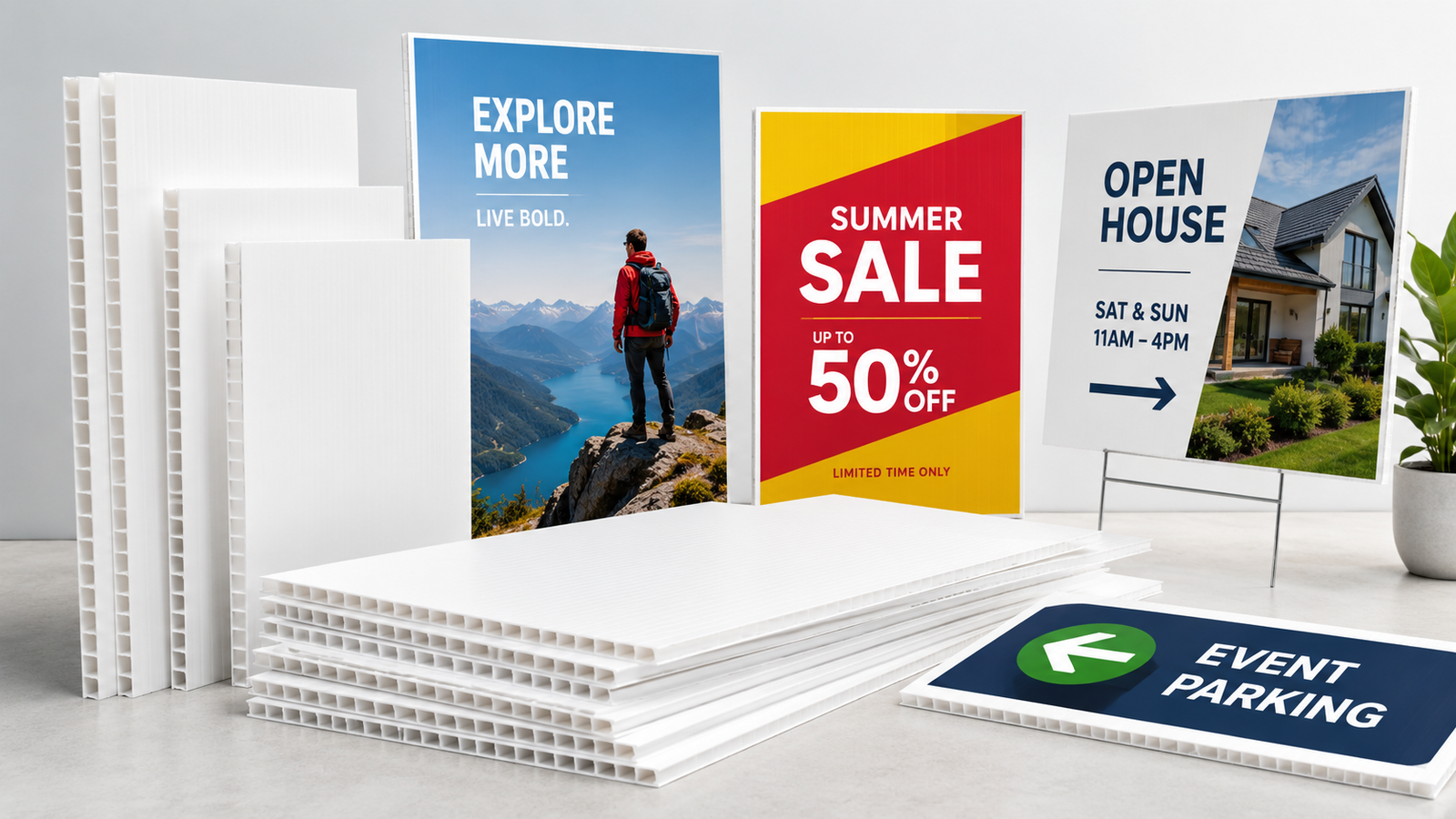
PP hollow sheet is widely used for yard signs, real estate signs, event signage, retail promotions, and other outdoor advertising applications. It is lightweight, water-resistant, easy to print, and more economical than many rigid sign materials.
However, different projects require different thicknesses, weights, surface treatments, and sheet structures. Choosing the right PP hollow sheet can improve print quality, durability, and installation performance.
PP hollow sheet, also known as corrugated polypropylene sheet, fluted plastic sheet, or PP corrugated board, is made from polypropylene.
It consists of two flat outer layers connected by internal flutes. This structure provides strength while keeping the sheet lightweight.
Common applications include:
PP hollow sheet is easy to transport, cut, mount, and install. It is especially suitable for large advertising campaigns that require many signs.
Unlike cardboard, polypropylene does not absorb water easily, making it suitable for rain, humidity, and damp environments.
With proper surface treatment, PP hollow sheet can be printed using UV flatbed printing, screen printing, or applied vinyl graphics.
For temporary or medium-term outdoor advertising, PP hollow sheet is generally more economical than acrylic, metal, PVC, or aluminum composite panels.
Common thicknesses include 2 mm, 3 mm, 4 mm, 5 mm, 6 mm, 8 mm, and 10 mm.
For most yard signs and temporary outdoor signs, 4 mm PP hollow sheet is a common choice because it offers a good balance of rigidity, weight, and cost.
Thinner sheets are suitable for lightweight displays, while thicker sheets are better for larger signs or projects that require more strength.
Consider:
Sheets with the same thickness may have different weights, usually measured in grams per square meter.
A heavier sheet often provides better rigidity and impact resistance. Very low-density boards may bend easily or have uneven surfaces.
Look for:
Polypropylene naturally has low surface energy, so untreated sheets may have poor ink adhesion.
For direct printing, choose corona-treated PP hollow sheets. Ask the supplier whether the sheet is treated on one or both sides and whether it is suitable for UV or screen printing.
Because surface treatment can weaken over time, test ink adhesion before mass production.
White PP hollow sheet is the most common choice because it provides a clean printing background and accurate color reproduction.
For double-sided printing, choose a higher-opacity sheet to reduce image show-through under strong light.
UV printing is suitable for full-color graphics and fast production. The sheet should be flat, properly treated, and compatible with UV ink.
Screen printing works well for large quantities and simple designs. Use ink designed for polypropylene.
Vinyl can be applied to clean, dry PP hollow boards for short runs and custom signs.
For short-term advertising, standard PP hollow sheet is usually sufficient.
For longer outdoor use, consider:
For permanent outdoor signs, aluminum composite panel or metal may be more suitable.
Large signs may bend or twist in windy locations.
For better performance:
For H-stake yard signs, the flutes normally need to run vertically so the wire stake can slide into the channels.
Flute direction also affects stiffness, printing layout, cutting, and folding.
Common finished sign sizes include:
Choosing the correct master sheet size can reduce waste and production costs.
Confirm:
PP hollow sheet is more resistant to water and outdoor conditions.
PP hollow sheet is lighter and more economical, while PVC foam board is more rigid and has a solid surface.
Aluminum composite panel is stronger and better for long-term signage, but it is heavier and more expensive.
Acrylic offers a premium appearance but costs more and may crack under impact.
Avoid these common purchasing mistakes:
A 4 mm white printable PP hollow sheet is commonly used.
Choose a rigid, high-opacity sheet suitable for double-sided printing.
A lightweight 4 mm sheet is usually sufficient for short-term use.
Use a heavier or thicker board for longer outdoor exposure.
LinkQ supplies high-quality advertising materials for printing, signage, display, and promotional applications.
We can help customers select the right:
Whether you produce yard signs, retail displays, event signs, or custom advertising boards, LinkQ can provide suitable PP hollow sheet solutions.
Choosing the right PP hollow sheet depends on thickness, weight, surface treatment, opacity, flute direction, printing method, wind exposure, and expected service life.
For many temporary outdoor signs, a printable 4 mm white PP hollow sheet offers a good balance of durability, print quality, weight, and cost.
Contact LinkQ to learn more about PP hollow sheets and professional advertising materials for your next signage project.