Address
304 North Cardinal St.
Dorchester Center, MA 02124
Work Hours
Monday to Friday: 7AM - 7PM
Weekend: 10AM - 5PM
Address
304 North Cardinal St.
Dorchester Center, MA 02124
Work Hours
Monday to Friday: 7AM - 7PM
Weekend: 10AM - 5PM

LinkQ ——Link The World With Quality
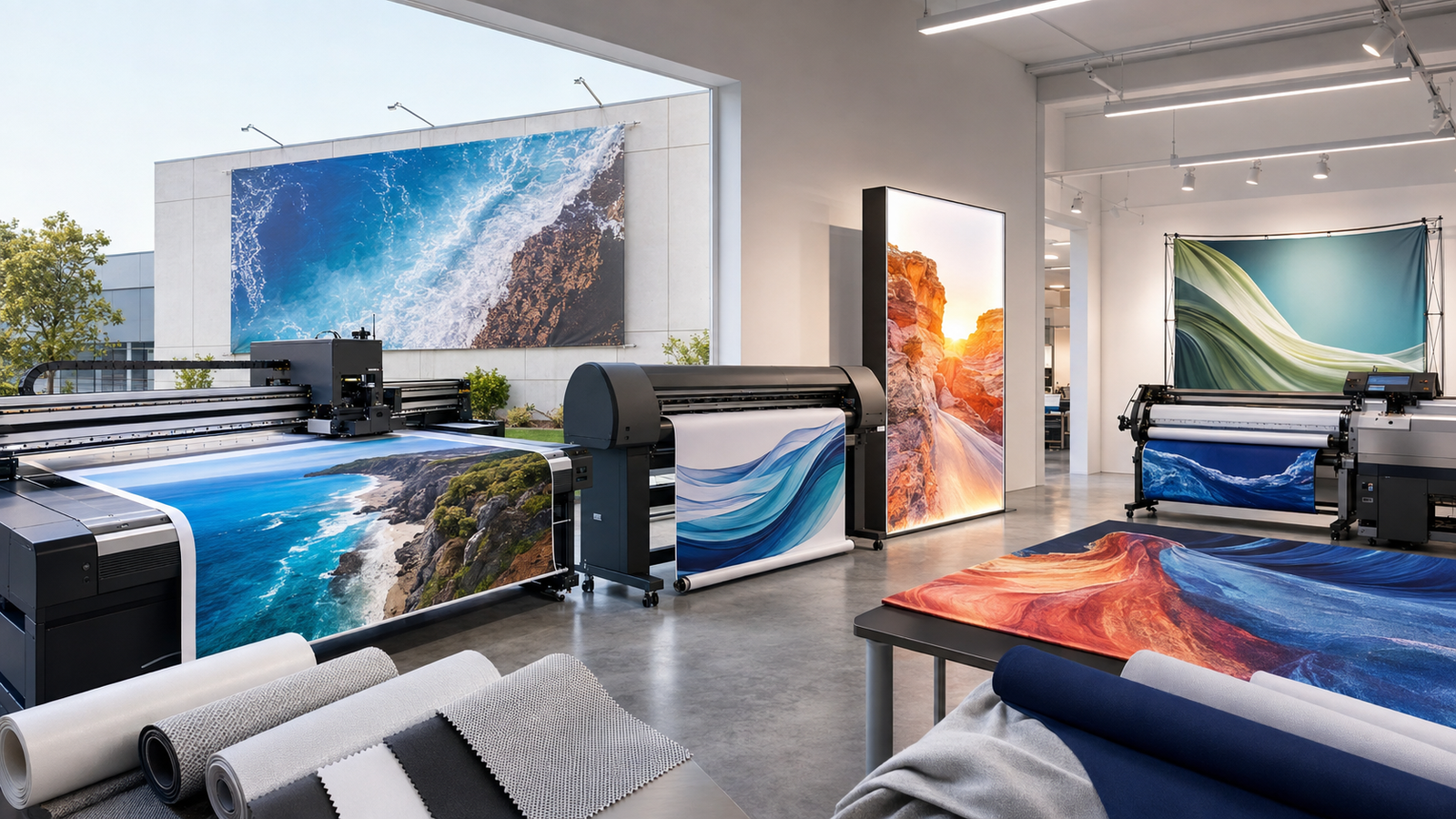
Selecting banner fabric is not simply a matter of choosing a roll that fits the printer. The material must match the ink technology, finishing, display hardware, lighting, fire-safety requirements, and service environment. A fabric that excels in a trade-show frame may fail outdoors, while a tightly woven banner can be wrong for a windy fence despite excellent print quality.
Media selection affects color, ink adhesion, dimensional stability, finishing speed, and profitability. This guide explains how to choose printable banner fabric for indoor, outdoor, frontlit, backlit, day-and-night, and specialty applications.
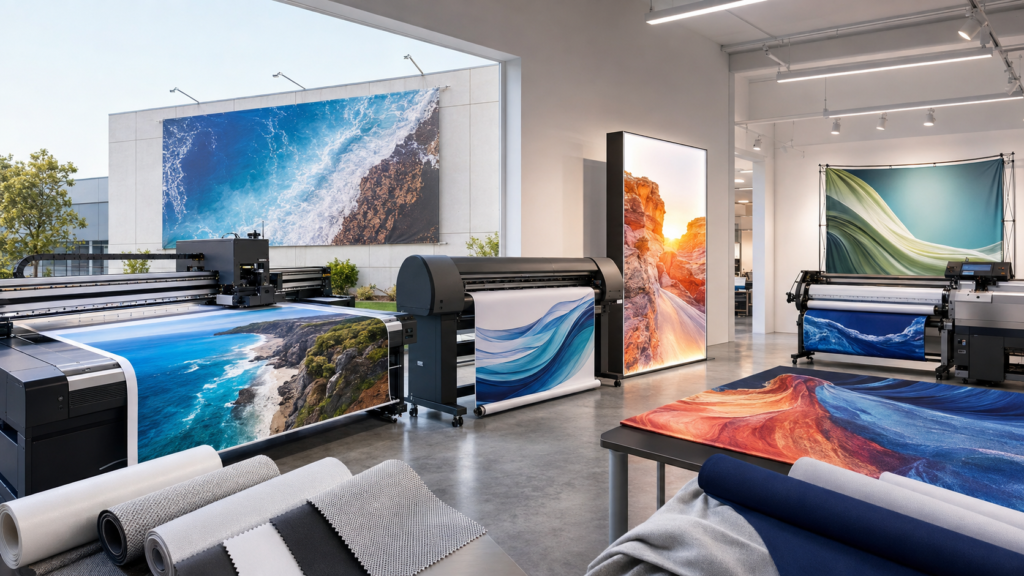
Before comparing specifications, answer five questions:
These questions are more useful than starting with fabric weight alone. Two products with similar weights can behave very differently because of their yarn, weave, coating, opacity, stretch, and surface treatment.
The term “banner fabric” includes several textile constructions. It may also be used loosely for flexible sign media, including coated nonwoven or composite products. Always confirm the actual base material and coating before printing.
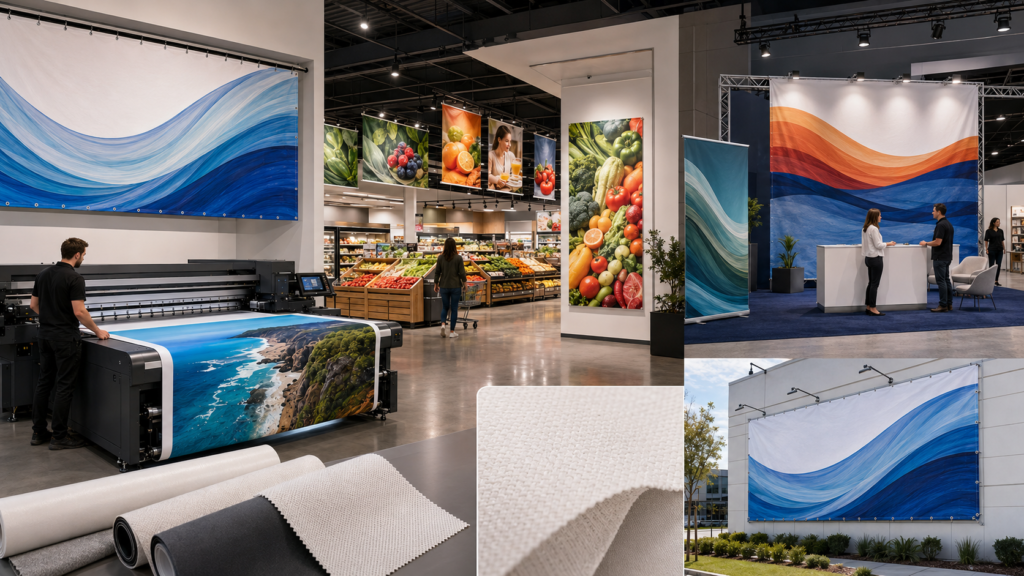
Frontlit fabric is designed to be illuminated from the viewer’s side. It normally has a white printable face engineered for strong reflected color. Polyester versions are popular for indoor banners, retail graphics, event backdrops, wall displays, and lightweight hanging signs. Compared with conventional PVC banner, textile media usually provides a softer, more premium appearance and can be folded for lower shipping volume.
A matte surface reduces glare under exhibition lighting and makes the graphic easier to photograph. A tighter weave or printable coating generally improves detail and color density, although it may reduce softness or air permeability.
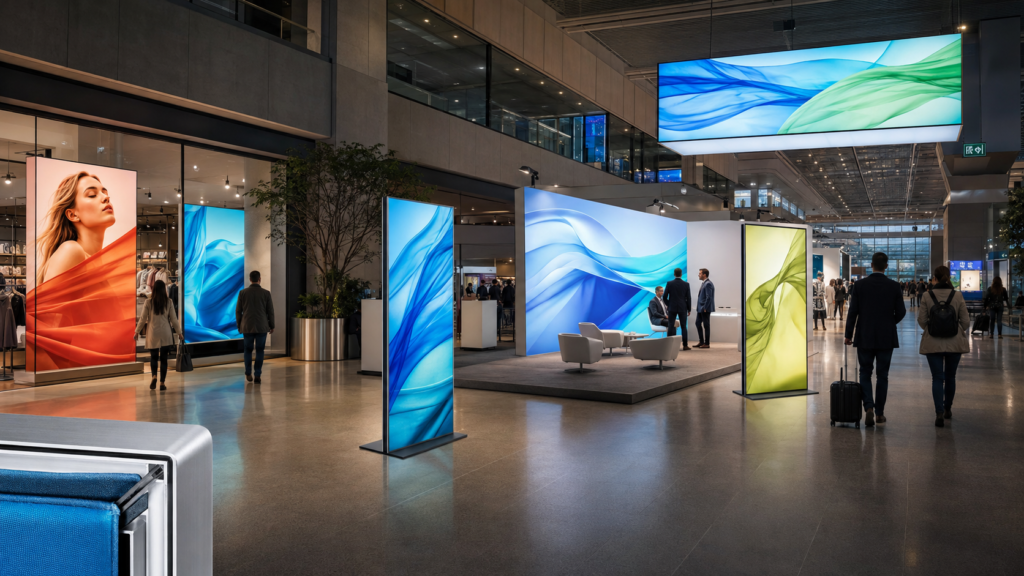
Backlit fabric is made for lightboxes and illuminated frames. The material must diffuse light evenly while maintaining sufficient ink density. If it transmits too much light without diffusing it, lamps or LED points may become visible. If it is too opaque, the display loses brightness and color impact.
Backlit textile is commonly used in retail lightboxes, airports, malls, exhibitions, restaurants, and branded interiors. Many products are polyester fabrics intended for dye sublimation, while others carry coatings formulated for latex or UV printing. The correct product should produce a uniform glow, smooth gradients, rich blacks, and consistent color across seams or panels.
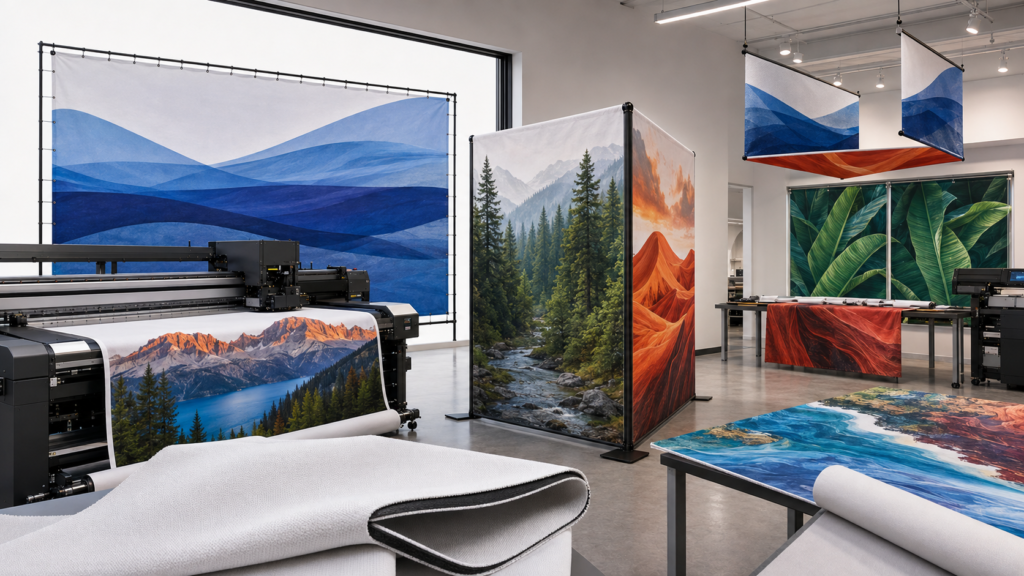
Blockout fabric contains a light-blocking layer, often black, gray, or opaque white, between or behind printable surfaces. It prevents light and visual information from showing through. Use it for hanging banners near windows, double-sided graphics, room dividers, event structures, and displays where the background would otherwise interfere with the image.
Some blockout fabrics are printable on one side; others are engineered for two-sided printing. Do not assume that an opaque material is automatically suitable for double-sided production. Confirm whether both surfaces accept the intended ink and whether registration tolerances meet the job requirements.
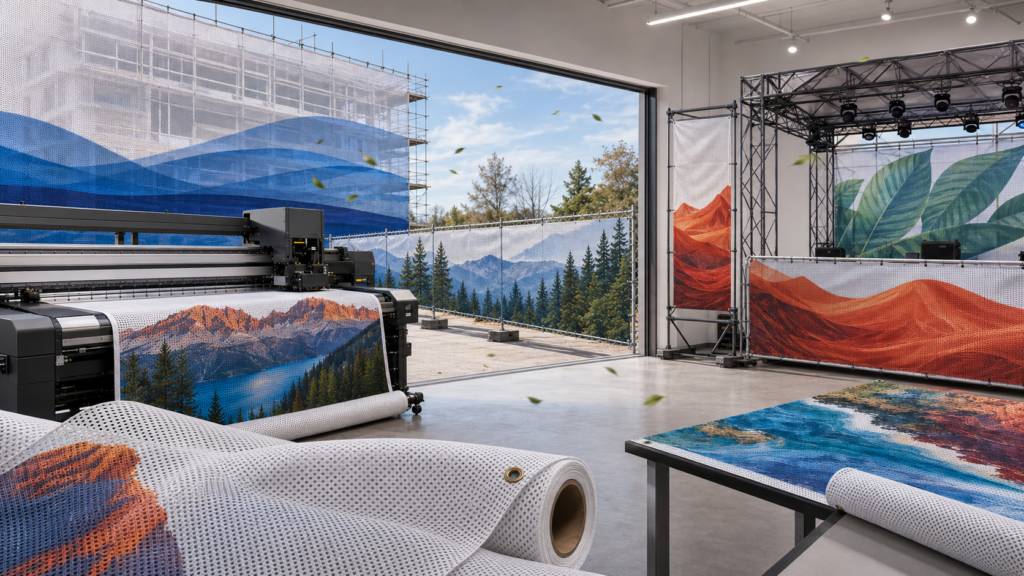
Mesh has an open construction that allows wind and some light to pass through. It is used for fences, building wraps, scaffolding, stages, speaker covers, and other large graphics exposed to airflow. The percentage of open area affects wind permeability, image density, and visibility. A more open mesh reduces wind load but also reduces printable surface area and color saturation.
Mesh should be selected as part of an engineered installation. Fabric permeability does not eliminate structural load. Large exterior graphics require appropriate attachment spacing, reinforced edges, safe hardware, and approval based on local conditions.
Lightweight knitted polyester suits flags where movement and show-through are desirable; the reverse image is normally mirrored and less saturated, not truly double-sided. Textured canvas is selected for wall décor and hospitality graphics. Stretch polyester supports exhibit structures, pillowcase displays, curved forms, and silicone edge graphics. For each, confirm ink compatibility and test stretch in both directions.
UV printers cure ink on or near the surface of the media using ultraviolet energy. They can print on a wide range of coated and uncoated materials, making UV technology versatile for specialty fabrics, blockout products, mesh, and rigid or flexible sign media.
For UV-printable fabric, focus on ink adhesion, surface cracking, hand feel, fold resistance, and curing settings. Because UV ink forms a film, excessive ink can stiffen a soft textile. Heavy ink coverage may crack when the fabric is folded, sewn, stretched, or repeatedly installed. Flexible UV ink sets can improve performance, but the result depends on the exact printer, ink formulation, lamp energy, and media coating.
Choose UV printing when you need:
Before production, test a high-coverage image and allow the print to rest for the supplier’s recommended period. Perform a dry-rub test, wet-rub test if relevant, scratch test, fold test, tape adhesion test, sewing test, and stretch test. Examine the result under both warm and cool light. A print that appears cured may still fail during finishing if the ink layer is too brittle or the coating is poorly matched.
UV printing can be excellent for outdoor fabric, but “UV ink” does not automatically make every fabric weatherproof. The base textile, coating, sewing thread, edge reinforcement, and hardware must also resist water, sunlight, temperature changes, and wind.
Latex printers use water-based ink and heat to dry and cure the print. Compatible coated fabrics can deliver strong color, low odor, and finished graphics that are ready for handling soon after printing. Latex is widely used for retail environments, wall graphics, exhibition displays, banners, and some outdoor applications.
The most important variable is heat compatibility. Lightweight or loosely constructed fabric may shrink, wave, skew, or distort as it passes through the printer. A suitable latex fabric should remain dimensionally stable at the printer’s required drying and curing temperatures. It should also have a coating that controls ink spread and supports the target color density.
Choose latex printing when you need:
Run a profile designed for the exact media whenever possible. If no profile exists, begin conservatively and adjust ink density, curing temperature, inter-pass delay, vacuum, tension, and advance calibration. Too much heat can deform the textile; too little may leave ink insufficiently cured. Too much ink can cause coalescence, tackiness, or weak abrasion resistance.
Latex users should also check edge curl and dimensional change before cutting silicone edge graphics. Even a small size change can create loose corners or excessive tension in a frame. Print and cure a measured test strip, let it cool, and compare its final dimensions before calculating the cut size.
Dye sublimation is generally the preferred process for premium polyester graphics. Sublimation dye becomes a gas under heat and bonds with polyester at the molecular level. The result retains the fabric’s soft hand, flexes without a surface ink film, and can produce vivid color with excellent resistance to rubbing.
There are two principal workflows. Transfer sublimation prints the image onto transfer paper and then uses a calendar heat press or flat press to transfer it to polyester. Direct sublimation prints onto a specially prepared fabric, followed by heat fixation when required by the system. Transfer printing often provides excellent detail and process control, while direct printing can simplify certain high-volume applications and may produce better penetration for flags. The best option depends on equipment, fabric, image, and end use.
Choose dye sublimation when you need:
Sublimation requires polyester or a polyester-coated printable surface. Natural fibers such as cotton do not form the same permanent dye bond unless specially treated, and blends may produce reduced density or a heathered appearance. Also account for heat shrinkage. Different textiles shrink at different rates across their width and length, and dark, high-coverage images may react differently from light designs.
Profile the complete system: printer, ink, transfer paper, fabric, heat press, temperature, dwell time, and pressure. Changing any component can change color. Test for ghosting, paper cockling, dye migration, yellowing, moiré, and uneven heat. For backlit work, inspect the final print inside the actual lightbox rather than judging it only on a table.
Indoor graphics are protected from rain and strong wind, but they still present demanding requirements. Close viewing distances reveal weave irregularities, banding, color inconsistency, and finishing defects. Retail and exhibition lighting can create glare. Public venues may also require documented flame-retardant performance.
For indoor frontlit banners, choose a matte, smooth textile with sufficient opacity to hide the wall or frame behind it. For photo backdrops, low glare is essential, and the weave should be fine enough to avoid visible texture or moiré on camera. For ceiling banners, low weight reduces the burden on hardware, but the fabric must hang straight and resist edge curl.
For silicone edge graphics, select a dimensionally stable stretch fabric matched to the frame depth and silicone strip. For free-standing displays, choose a fabric whose stretch direction matches the hardware. For decorative canvas, prioritize texture, color gamut, and edge quality during stretching.
Always ask whether a flame-retardant certificate is required. Requirements vary by jurisdiction, building, venue, and application. Obtain current documentation for the exact product and production lot when necessary; a generic statement about polyester is not a substitute for an applicable test certificate.
Outdoor banner fabric must resist ultraviolet exposure, temperature cycling, abrasion, wind, moisture, and stress at its attachment points. Start with a product explicitly rated for the expected exterior duration. Coated frontlit polyester can suit protected short-term banners, while breathable mesh is often better for fences or exposed building graphics. Do not use a soft indoor textile outside merely because its ink is water resistant.
Reinforced hems, webbing, grommet spacing, pole pockets, keder, stitching, and thread may determine whether the installation survives. Outdoor-life claims remain estimates because orientation, climate, ink density, cleaning, and installation quality all matter. Large graphics require an appropriate structural and wind plan.
Lighting changes both material requirements and color perception.
For graphics lit from the front, reflected color and surface finish are the priorities. A bright white point supports a wider perceived gamut, while a matte finish controls glare. High opacity prevents background colors or frame components from contaminating the image. Frontlit media normally requires a standard reflective print profile rather than the elevated ink density used for backlit displays.
Backlit fabric must balance transmission, diffusion, and ink density. A conventional frontlit fabric may look dull or uneven when illuminated from behind. Select media designed for lightboxes and profile it in the illuminated state. Dense colors and neutral grays are particularly important because transmitted light exposes color imbalance.
The lightbox also matters. LED spacing, box depth, diffuser panels, edge lighting, color temperature, and brightness affect the result. A good fabric cannot fully correct a poorly designed light source. Test the actual combination whenever uniformity is critical.
A common challenge is a lightbox that must look rich during the day with the lights off and brilliant at night with the lights on. A single standard ink layer is usually a compromise: enough density for daytime viewing may become too dark when illuminated, while density optimized for backlighting may look pale when the lights are off.
Several solutions are possible:
Layered UV printing requires careful testing because additional ink can reduce flexibility and alter the fabric’s surface. For any day-and-night project, approve physical samples under three conditions: ambient daylight, artificial front light, and the final lightbox with illumination on.
| Application | Recommended construction | Common print method | Key properties to verify |
|---|---|---|---|
| Indoor hanging banner | Matte frontlit polyester | Latex, UV, or sublimation | Opacity, low curl, smooth hanging, flame rating |
| Retail lightbox | Backlit polyester | Sublimation, latex, or UV | Diffusion, transmission, color density, shrinkage |
| Silicone edge graphic | Stretch or backlit SEG textile | Sublimation; compatible latex or UV | Controlled stretch, dimensional stability, frame fit |
| Trade-show backdrop | Wrinkle-resistant stretch fabric | Sublimation or latex | Fold recovery, matte finish, sewing performance |
| Outdoor fence graphic | Printable mesh | UV or latex | Open area, edge strength, outdoor rating, wind plan |
| Outdoor frontlit banner | Coated exterior-rated fabric | UV or latex | Water resistance, adhesion, tear strength, reinforced finishing |
| Double-sided hanging sign | Blockout fabric | UV, latex, or sublimation-compatible product | Opacity, two-side printability, registration, curl |
| Flag or feather banner | Lightweight knitted polyester | Direct or transfer sublimation | Show-through, tear resistance, stretch, edge finishing |
| Fine-art wall décor | Canvas or textured polyester | UV, latex, or compatible pigment process | Texture, color gamut, cracking, stretchability |
| Stage or speaker graphic | Acoustic or open mesh textile | Sublimation, UV, or latex | Sound transparency, flame rating, image density |
This table is a starting point. The manufacturer’s compatibility declaration and an in-house production test should make the final decision.
Fabric weight affects handling, but it does not predict performance by itself. Confirm fiber composition, woven or knitted construction, ink-receptive coating, printable side, whiteness, opacity, light transmission, stretch in both directions, dimensional stability, and tear strength. Polyester is required for conventional sublimation, while visually similar UV and latex products may use very different coatings. For public interiors, request an applicable, current flame-performance certificate. When sustainability claims matter, ask for documentation covering recycled content, PVC content, restricted substances, emissions, and available recycling routes.
A controlled sample test prevents expensive failures. Use the actual printer, ink, RIP, finishing equipment, and installation method. Include small text, gradients, neutral gray, saturated colors, skin tones, deep black, and heavy total ink coverage in the test image.
For UV, test adhesion, scratching, folding, stretching, sewing, and grommeting. For latex, test curing, rub resistance, heat deformation, edge curl, and size after cooling. For sublimation, test transfer uniformity, shrinkage, ghosting, dye migration, and color under final illumination.
Simulate the real use: fold a trade-show textile, tension an SEG sample in its frame, illuminate backlit fabric in the customer’s box, and test seams and fasteners—not only the printed center. Record the successful profile, ink limits, temperature, speed, tension, measured shrinkage, finishing method, supplier code, and roll lot. This turns media selection into a repeatable production system.
Avoid buying by price and weight without confirming ink compatibility; using frontlit media in a lightbox; assuming all polyester is sublimation-ready; ignoring shrinkage until after printing; judging a backlit print only with its lights off; or treating outdoor performance as an ink-only issue. Fabric, coating, thread, hems, hardware, frame, lighting, and site exposure operate as one system. Confirm fire-documentation requirements before ordering material for public interiors.
LINKQ Group supplies advertising and printing materials for a range of visual communication applications. For a useful recommendation, provide the printer model, ink type, required width, indoor or outdoor use, lighting condition, finishing method, expected duration, and documentation requirements. We can help narrow the options and support sample evaluation before a larger order. Final suitability should be confirmed through production testing because equipment, profiles, finishing, and installation conditions differ.
contact us nowContact : lynn@linkqgroup.com
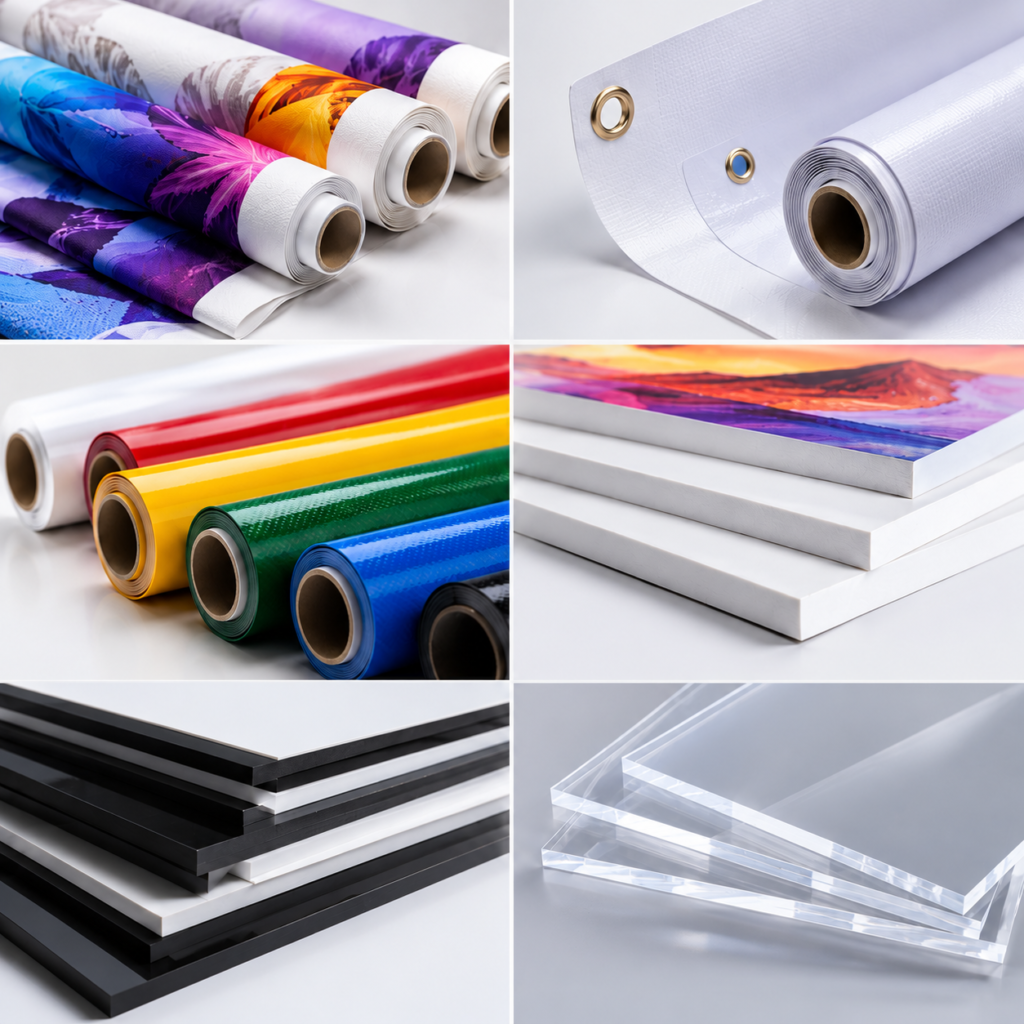
Choose banner fabric by working backward from the finished display. Start with the environment and lighting, then determine the construction, print technology, finishing method, and compliance needs. For UV printing, prioritize adhesion and flexibility. For latex, prioritize coating compatibility and heat stability. For dye sublimation, choose polyester engineered for the transfer or direct process and control heat shrinkage carefully.
Use frontlit fabric for reflected-light graphics, purpose-built backlit fabric for illuminated displays, blockout construction when show-through must be eliminated, mesh where controlled airflow is needed, and stretch fabric for tension frames. For displays used with lights both off and on, test the exact media, ink density, print layering, and lightbox configuration in both conditions.
The correct material should produce attractive color, finish efficiently, install cleanly, meet safety requirements, and remain consistent throughout its expected life. A documented media test is a valuable investment.
A purpose-designed backlit polyester with controlled light diffusion is usually the best starting point. Dye sublimation is widely used for premium textile lightboxes, while coated backlit fabrics may be compatible with latex or UV printers. Test the fabric inside the actual lightbox and evaluate color, black density, hot spots, and dimensional fit.
It can be used outdoors when the polyester fabric, dye set, finishing, and installation are designed for exterior exposure. However, many sublimation textiles are intended primarily for indoor events and retail displays. Confirm the product’s outdoor rating and expected duration rather than relying on the print process alone.
Blockout fabric prevents light and background images from passing through, while backlit fabric is designed to transmit and diffuse light. They serve opposite optical purposes. Blockout is useful for double-sided or high-opacity signs; backlit media is used in illuminated lightboxes.
No. Mesh is helpful where airflow is important, especially on fences or large exposed installations, but it reduces printable area and image density. Smaller or protected outdoor banners may use exterior-rated frontlit fabric. The installation should be evaluated for wind load and structural safety regardless of material.
Use a backlit fabric with balanced diffusion, create a profile for the display, and approve physical samples in both states. Higher ink density or UV layered printing may improve day-and-night performance, but each involves tradeoffs in transmitted brightness, reflected color, flexibility, and production time.
Suggested call to action: Need help selecting printable banner fabric for a UV, latex, or dye-sublimation workflow? Contact LINKQ Group with your printer model, application, lighting condition, required width, and finishing method to request a suitable material recommendation or sample.
contact us nowContact : lynn@linkqgroup.com